Archive for the ‘Dagenham’ Category
Local history Monday Tuesday
Tuesday, March 18th, 2008
Whalebone Lane, bit of an odd name for a main road in a town not exactly famed for its whaling fleets, isn’t it? Well, the name derives from Whalebone House, that stood close to the junction of the modern-day High Road and Whalebone Lane. The house taking its name from the large whalebone arch that formed the main gate.
The house was destroyed in bombing in April 1941, not much survived, although the whalebones did, being transfered to Valance House, where they were recently rediscovered.
There had been a house on the site since at least 1667, the house shown in the photograph above dated from around 1747. What follows is a somewhat incomplete history of the house and owners:
- c1667 Owned by a Mr. Bell (no further details)
- c1747 Daniel Pilon constructed the house shown in the photograph.
- 1783 Nicholas Peter Pilon
- 1823 to 1846, used as a school by John Peacock
- 1846 to 1855, owned by the Mull family. Sold off on August 10th 1885 by auction.
- 1887 Alexander Anderson
- 1889 to 1917 Philip Savill and Mrs M. Savill
- 1920 Reginald Wood
- 1922 Walter Hayter
- before 1941, owned by Mrs Lester.
When exactly and why the whalebones made their appearance, I’ve not yet been able to discover - anyone know?
Lost Dagenham
Sunday, December 9th, 2007Another image from the archives this week: Clay Cottages of Marston Avenue. You won’t find them there now though, these last two were demolished in 1962, razed to make room for garages.
These particular cottages were around 500 years old - some of the oldest dwelling places in Essex. They originally had no first floor, this being added fairly recently. In our enlightened times there would probably be a cry to save them from destruction. In the 1960s however, the low ceilings and lack of modern facilities condemned them.
I’ve reason to believe even the garages that replaced them are now gone.
The Oldest Road
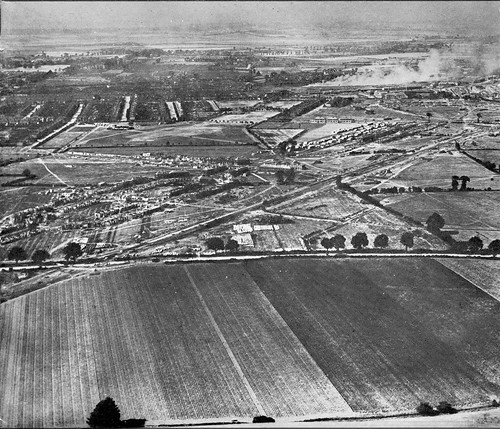
Monday, November 5th, 2007High Road follows the path of an old Roman road from Colchester in Essex to London and is one of the oldest in the UK. It has been in use for at least two thousand years. The junction is where Whalebone Lane South and North meet the High Road. The areas of fields and allotments along side the roads are all houses and shop now. The pond visible on the left of the image is now covered by industrial areas along Selina’s Lane.
The difference a decade makes…
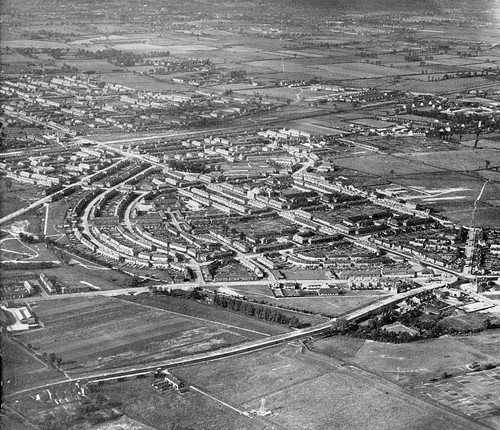
Monday, October 29th, 2007Continuing from last week’s theme of the construction of Dagenham, we move to the area around Dagenham parish church and see how it changes over a period of ten years.
This first image shows the Leys Field and Church Elm Lane as they were c.1950. Leys in an old name for this area, dated to at least the mid 1600s from archive documents.
Snaking down the photograph to the right of the church is the Wantz stream, not culverted until later in the 1960s and at this point still prone to summer flooding. In the early 1950s there were plans to develop the Leys field into another large park similar to Central Park or Parsloes.
Just ten years later (c.1960) and the need for housing has lead to development of the portion of Leys field close to the church. The ambitious park plans of the 1950s have found fruit in the form of Old Dagenham park, constructed from the remainder of the Leys, and just outside the field of view of the second photograph.